
Something You Feel, Not Something You Are
Kia ora e te whānau,
I was reading over the earliest posts that I wrote here on Substack, looking for inspiration in a week that’s felt pretty heavy. And I realised that when I wrote about my DHSc research themes Connection & Belonging, Safe & Supported Practice and Creating Roles People Want to Come For, I never wrote one about the concept of Fit, woven throughout those themes.
There was a pattern I heard over and over again in my DHSc research with rural Allied Health Professionals across Aotearoa.
A talented clinician joins a rural team. They have the right qualifications. They seem enthusiastic. The role looks good on paper, the incentives are in place. And then, within a year or two, they’re gone.
Sometimes they could name why. More often, they couldn’t. They just knew something wasn’t working.
It was this concept in my research that I called Fit.
More than a checklist
When workforce researchers and health managers talk about “fit” in rural health, they usually mean have a checklist in mind. Were you born rurally? Did you train rurally? Do you have rural connections? The assumption is that someone who ticks these boxes will be a better long-term prospect for a rural community.
There’s evidence for this. Rurally born health professionals are statistically more likely to work rurally. Rural training placements increase the likelihood of rural employment after graduation. These patterns are real and they matter for pipeline planning.
But across the 18 rural Allied Health Professionals I interviewed for my doctoral research, I found something more.
Fit is something you feel, not just something you are.

What Fit actually looks like
One participant put it simply: “I’m thankful to be here. It’s good to know you’re where you’re supposed to be.”
Another described their rural role as “it’s like my dream job” — not because rural work is inherently easier or more comfortable (it isn’t), but because the role allowed them to use their skills in ways that felt fulfilling, their values were aligned with the place and the mahi, and they could envisage their future from where they were standing.
A third participant, whose parents had been rural schoolteachers, didn’t identify as rural at all. They’d grown up, gone to university in the city, built a career. But when they moved to a rural role, something clicked. “Being a public servant in a rural area feels very familiar,” they said. They hadn’t expected to feel it. But they did.
Fit isn’t about where you were born or what’s on your CV. It’s an inner sense of being in the right relationship with your purpose, your place, and the people around you.
When Fit is lost
The flip side is just as telling. One participant reflected on a conversation with a former colleague who had left a hospital role. She asked: would you come back?
The response was immediate. The colleague said no, absolutely not — the place didn’t fit who she was. No long list of grievances. No ‘navel gazing’. Just a clear felt sense that this was not her place anymore, and that was enough.
This is what makes Fit so significant for retention. When it’s present, people stay even when things are hard. They carry the weight of workload pressures, the isolation, the professional complexity of rural generalist practice, because the overall sense of belonging in that place outweighs the difficult parts.
When it’s gone, all the incentives in the world won’t bring it back.
Allied – Insights for a Thriving Rural Workforce is a reader-supported publication. To receive new posts and support my work, consider becoming a free or paid subscriber.Subscribe
Fit runs through everything
This is where Fit gets interesting from a research perspective. It doesn’t sit alongside the other themes I identified — Sense of Connection and Belonging, Safe and Supported Practice, and Creating Roles People Want to Come For. It runs through all of them.
You can feel Fit within your team, within your professional support structures, and within the role itself. But there is also a broader sense of Fit that encompasses all of this; a felt sense of being in the right space, at the right time, for the right reasons.
And here’s the finding that most surprised me: having an overall sense of Fit appeared to outweigh the more particular ideas in each individual theme. People who had a strong overall sense of Fit could manage a lack of fit in one specific area. But when the overall sense was gone, the specifics didn’t carry much weight.
What this means in practice
If Fit is primarily something people feel rather than something they inherently are, this changes how we should be thinking about rural health workforce strategy.
The checklist approach to identifying “rural types” will always leave capable people out, including those who haven’t yet had the chance to discover that rural practice might be exactly right for them. Rural training placements work not because they identify people who are already rural, but because they create the conditions for people to find their Fit.
Recruitment conversations need to go beyond qualifications and logistics. The questions that matter are about values, about what someone finds meaningful, about what kind of relationship they want with a community.
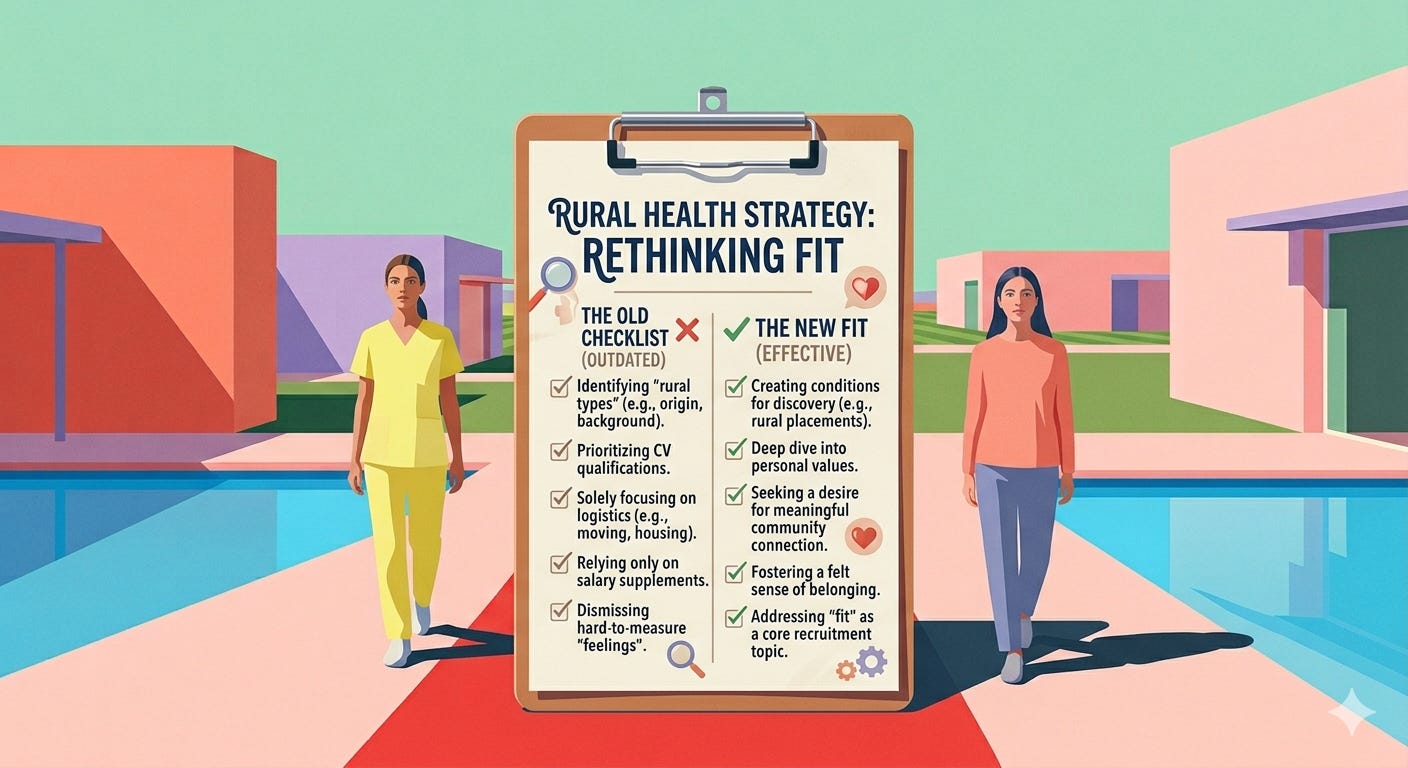
Retention strategies that focus only on incentives and conditions are addressing the wrong problem. A salary supplement doesn’t replace a felt sense of belonging.
And when a good clinician leaves a rural role without being able to fully articulate why, that’s worth paying attention to. Fit is hard to measure. That doesn’t mean it isn’t real.
The thread underneath
As I mentioned at the start of this post, Fit is the fourth concept or theme that came out of my doctoral research, and it might be the most significant, because it’s the thread that weaves through all three.
It’s also the one I find most hopeful. If Fit is something people feel rather than something fixed about who they are, then it’s something we can create the conditions for. That shifts the question from “how do we find the right person?” to “how do we build the kind of place where the right person can feel at home?”
And that, I think, is where rural health workforce strategy gets genuinely interesting.
Kia pai tō wiki,
Jane