

About Dr Jane George

Jane George is a researcher, strategist and speaker with a deep commitment to improving workforce sustainability - particularly in rural and complex health settings.
She is a registered social worker, a Fellow of the Australasian College of Health Service Management and an independent researcher whose work has helped reshape how Aotearoa thinks about allied health workforces.
Her mahi sits at the intersection of rural health, allied health professions, and systemic equity. She works with the conviction that health systems perform better when every profession is valued, every community has access, and the people closest to the challenges are part of designing the solutions.
Professional story
My career in health began as a volunteer ambulance officer and moved into ambulance communications. My experiences led me to qualifications in social work and psychology, working across many countries, sectors and roles, from social work practice in Aotearoa to mental health and social services in the United Kingdom.
I have worked in sexual violence, disaster response and recovery, crisis intervention, community development and education. Each setting deepened my understanding of how systems work, and how they fail the people they’re supposed to serve.
Appointed as Director of Allied Health, Scientific and Technical at the West Coast District Health Board crystallised my focus. Leading a diverse allied health workforce on West Coast of the South Island, Aotearoa’s most rural health district meant grappling daily with the gap between how health systems are designed (usually from urban centres) and how they actually need to work in communities where resources are limited, distances are vast, and every practitioner needs to work across the full breadth of their scope.
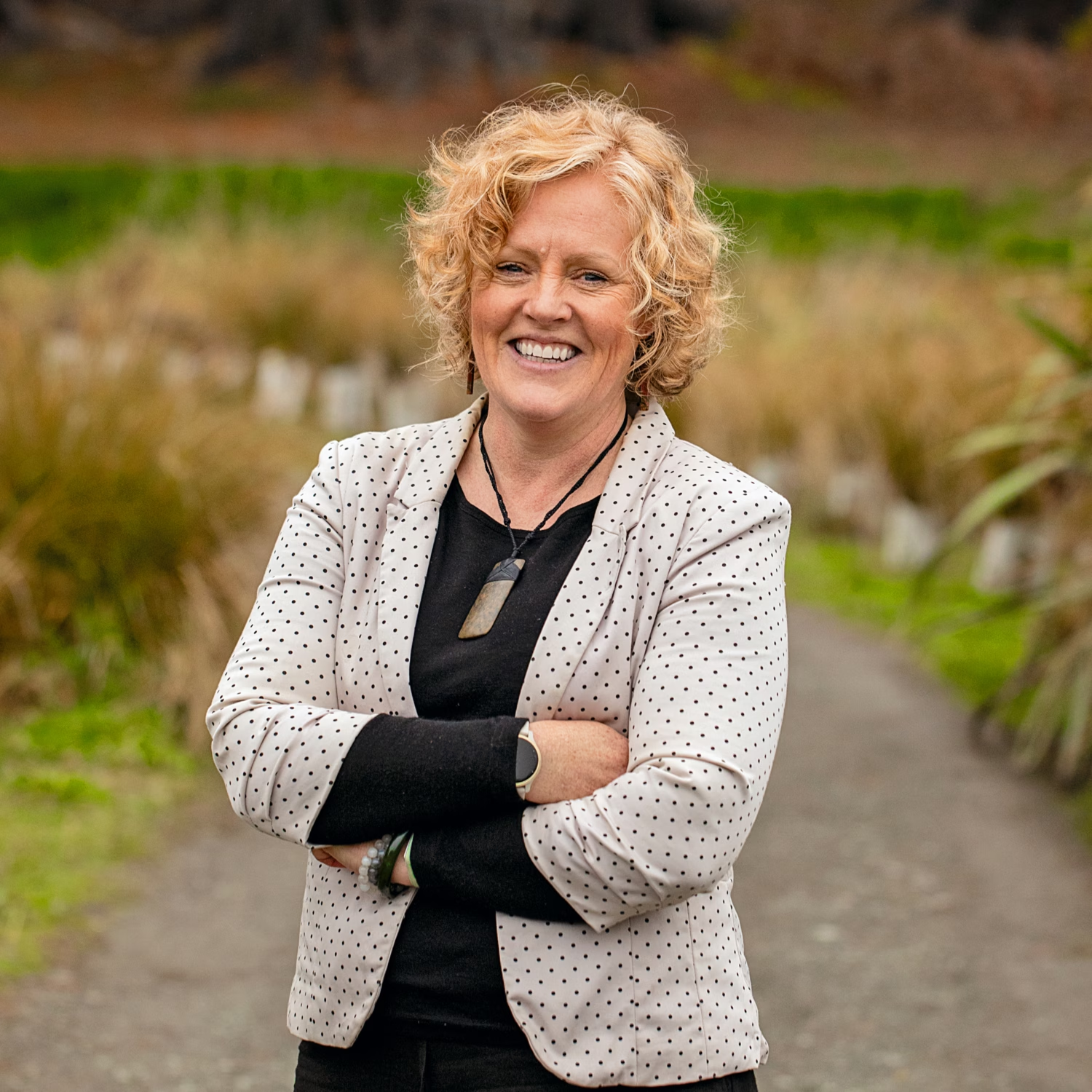

Jane views health systems through an innovative lens
I have seen rural practitioners developing elegant, integrated solutions out of necessity, while urban-designed policies and systems often made their work harder rather than easier. I saw allied health professionals providing critical clinical services yet remaining largely invisible in workforce planning and policy.
These observations became the foundation of my doctoral research, my consulting practice, and my growing presence as an international speaker and thought leader. Today, I work across Aotearoa and internationally, challenging geographical narcissism; the unconscious assumption that cities are where innovation happens, and advocating for health systems that recognise rural communities as sources of innovation, not just recipients of it.
I have taught and facilitated health and social policy development through two of Aotearoa’s leading universities, provides social work supervision and mentoring, and maintain active connections with Australian universities including Flinders.

Wendy Elwood, Runanga
Research with real-world impact
Jane’s approach to research is shaped by her social work training and her years of operational leadership. She believes research should illuminate what’s actually happening in health systems, particularly for the people and communities most affected by how those systems are designed.
Three principles guide her work:
Connection and belonging matter more than incentives.
Jane’s doctoral research found that what keeps allied health professionals in rural communities isn’t primarily about money or career pathways; it’s about whanaungatanga. Connection. Belonging.
Being part of a community and feeling valued within it. This finding challenges conventional recruitment and retention thinking and has practical implications for how organisations design roles, support their people, and build sustainable workforces.
Evidence should be interrogated, not just applied.
Jane’s research is grounded in a commitment to evidence-based practice, with a critical lens on the evidence itself. Where does it come from? Whose experiences inform it? What biases shaped the research questions, the methodology, the sample? Too often, evidence generated in urban settings with particular population groups is applied uncritically to rural communities, indigenous populations or professional groups it was never designed to represent.
Good evidence-based practice means building on the knowledge that practitioners and communities already hold, while questioning whether the published research actually applies to the context at hand. Or whether it’s being retrofitted to suit
You can’t build equity without naming inequity.
Jane’s social work lens brings a structural analysis to workforce research. She examines how professional hierarchies, urban-centric policy design, and resource allocation patterns create and maintain the very workforce challenges organisations are trying to solve. Understanding these dynamics isn’t an academic exercise.
It’s a practical prerequisite for designing solutions that actually work.
Qualifications & affiliations
- Doctor of Health Science
- Master of Social Welfare (endorsed in Supervision and Management)
- Postgraduate Diploma in Health Management
- Bachelor of Social Work
- Bachelor of Psychology
- Certified Health Executive, and Fellow, Australasian College of Health Service Management
- Registered Social Worker, Aotearoa
- Academic affiliation – Flinders University, Adelaide
- Research supervision or advisory roles
- Boards, panels, or advisory groups (if applicablae)
- Board Member – Mental Health Education and Resource Centre (MHERC)
- Clinical Co-Lead – Wāhine Connect (National Charitable Mentoring Network for Women in Health)